
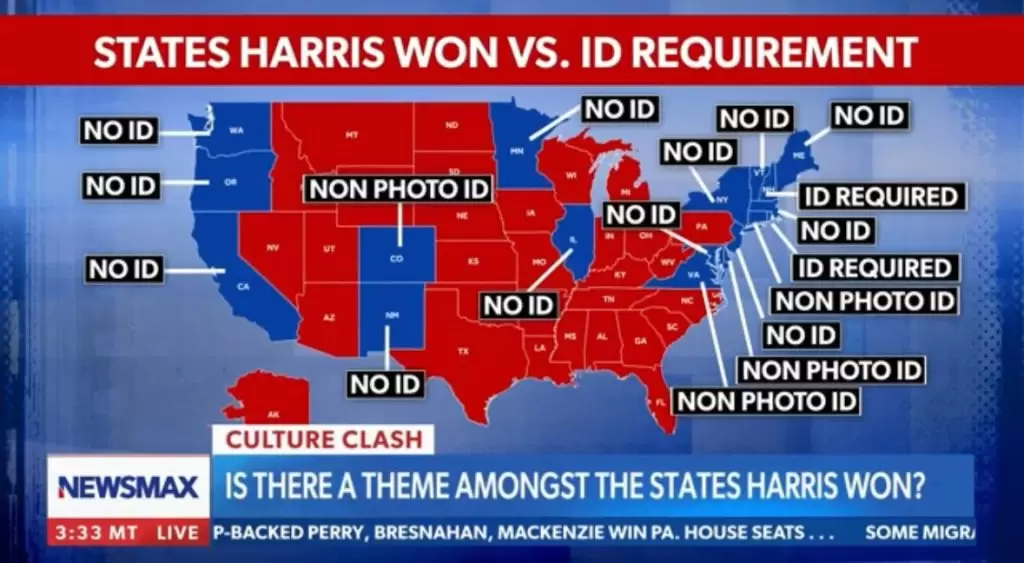
In a surprising yet predictable outcome of the 2024 U.S. presidential election, Vice President Kamala Harris emerged victorious in all states that have no voter ID requirement. Despite a landslide win for Donald Trump and Republicans overall, Harris’ win in these states raises new questions about the legitimacy of election policies and voter ID laws.
As of November 9, 2024, preliminary results show that Harris won in 17 states and the District of Columbia, including California, New York, and Illinois. These states, which have no voter ID requirement, represent a significant portion of the electoral map. New Hampshire and Rhode Island are the exceptions, with New Hampshire requiring voter ID, while Rhode Island mandates a form of identification for voters as well.
Trump, on the other hand, did not win a single state without a voter ID requirement. This divide has sparked further debate over voter ID laws and their impact on election outcomes. Some critics argue that the absence of such laws leads to a higher possibility of voter fraud, a sentiment that has continued to linger since the contentious 2020 election.
Preliminary results show Harris with a popular vote of 70.3 million (47.82%) against Trump’s 74.1 million (50.42%), with 95% of the expected vote counted. Despite Trump’s overall win in terms of popular vote and electoral college tally, Harris dominated the states with no voter ID.
Harris’s win in California, a state with no ID law, contrasts sharply with Trump’s loss in that same state, which has been a key Democratic stronghold for years. California not only has no voter ID requirement, but has recently made it illegal to even show ID in elections.
Trump’s defeat in these voter ID-free states raises questions for election reform advocates, who view this pattern as a sign that states without voter ID laws are more susceptible to widespread voter fraud.
The 2024 election has sparked renewed debates on how voter ID laws and election security are intertwined. With Trump winning in states that require voter identification but losing in those that do not, the discussion around voter access and security will likely remain in the spotlight for years to come.