
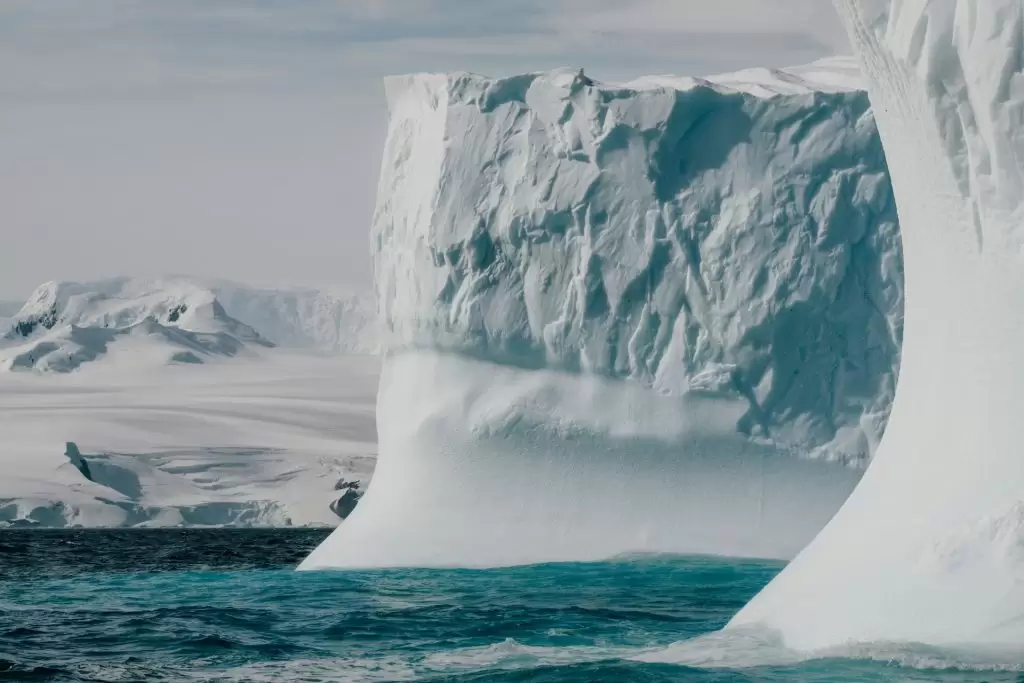
A recent study has revealed that sea ice around Antarctica has “slowly increased” since 1979, challenging long-standing claims of catastrophic loss due to climate change, writes the Daily Sceptic’s Environment Editor Chris Morrison. The paper, authored by four environmental scientists, attributes the fluctuations in sea ice levels primarily to natural climate variability rather than human activity.
The research observed a gradual expansion of Antarctic sea ice from the start of continuous satellite measurements in 1979 until 2014. A sudden decline followed from 2014 to 2019, but growth resumed shortly after, despite a brief dip in 2022. The authors concluded that these variations are influenced by natural atmospheric and oceanic patterns, aligning with data from earlier decades.
The findings echo a statement from the European Union’s Copernicus Climate Change Service, which noted that Antarctic sea ice has shown “large year-to-year variability and no clear long-term trend since 1979.” At the opposite pole, Arctic sea ice has also exhibited signs of stabilization, with its decline plateauing since 2007.
Critics of alarmist climate narratives, such as the Financial Times’ 2022 claim of a “catastrophic cascade of extreme environmental events,” have pointed out inconsistencies in predictions. Dr. Walter Meier of the U.S. National Snow and Ice Data Center has acknowledged historical Antarctic sea ice variability, noting extreme highs and lows in the 1960s that mirrored more recent trends.
The 2023 dip in Antarctic winter sea ice sparked widespread concern, with some calling it a new benchmark for the region’s susceptibility to global warming. However, the study’s findings suggest that Antarctica remains largely resistant to significant temperature changes over the last 70 years, further undermining claims of an impending environmental collapse.
Antarctica’s sea ice trends form part of a broader debate on the reliability of climate predictions and the role of natural variation. Proponents of Net Zero policies argue for immediate action to curb emissions, while critics point to the growing evidence of natural cycles dominating the climate system.
The study also challenges the mainstream science narrative often used to justify sweeping policy changes. With accurate temperature records spanning less than a century and significant adjustments to global datasets, researchers argue that natural factors play a more significant role in climate shifts than previously acknowledged.
Adding to the skepticism are recent findings in other areas of climate science. The Great Barrier Reef, previously reported to be in danger, has experienced record coral growth over the past three years. Similarly, Arctic polar bear populations remain stable, and new satellite data has identified expanding colonies of penguins in Antarctica.