
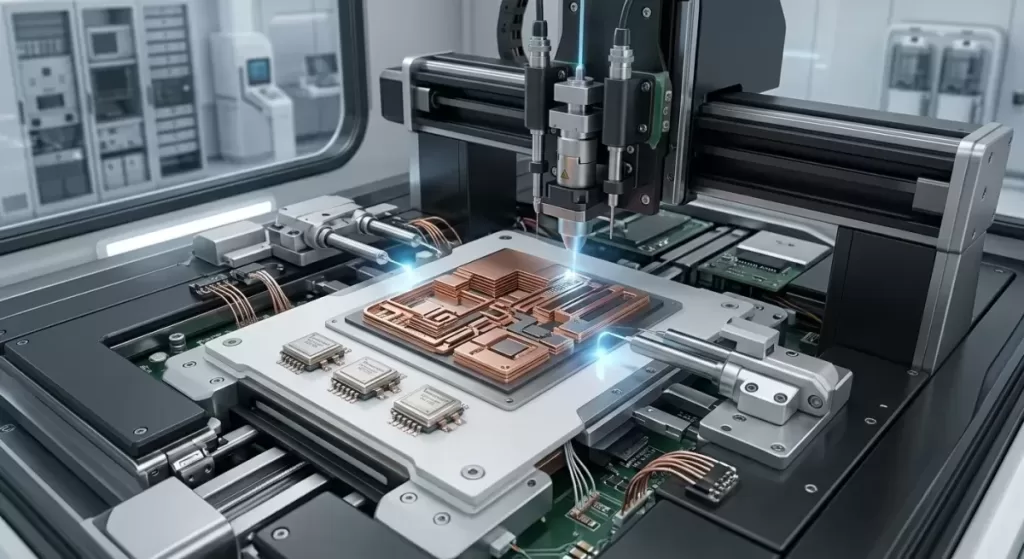
Jeff Holden, the former Amazon executive who helped create Amazon Prime, has emerged from six years in stealth with Atomic Machines, a manufacturing startup that has raised $250 million to develop machines directly from digital designs.
The company’s first product is PrimeSwitch PS-150, a high-speed power relay designed for 800-volt direct-current (DC) systems in artificial intelligence data centers. Holden says Atomic Machines’ Matter Compiler manufacturing system can produce different micro-machines from different code inputs without requiring new product-specific tooling.
Holden announced Atomic Machines’ launch after six years of development, describing its mission as achieving on-demand, universal control over the manufacturing of physical devices. The company is targeting micro-machines with moving parts and features measured in microns, a manufacturing category that conventional semiconductor fabrication equipment cannot easily accommodate.
How the Matter Compiler works
Traditional semiconductor factories specialize in manufacturing silicon chips through highly controlled processes, while producing a new mechanical device often requires dedicated tooling and extensive process development. Atomic Machines aims to remove that constraint by integrating digital design, manufacturing operations and precision measurement into a single system.
The Matter Compiler measures each manufacturing step, checks whether the physical result meets specifications and uses the collected data to improve subsequent operations. Holden describes the approach as a closed feedback loop in which artificial intelligence helps generate device designs and manufacturing instructions while the system adapts to errors.
Unlike conventional 3D printing, which primarily changes the shape of an object, Atomic Machines aims to manufacture different functional machines from different digital inputs. The long-term goal is to move toward production in which a digital prompt can generate a design and the system can manufacture the corresponding working device.
First product targets AI data centers
PrimeSwitch PS-150 is the startup’s first commercial product, built to address electrical protection challenges as AI data centers adopt 800-volt DC power architectures.
According to Holden, the relay supports 150 amperes of continuous current, has an on-resistance of 200 micro-ohms and measures 9.5 by 3 millimeters in a hermetically sealed package. It can open in approximately 50 microseconds and provide galvanic isolation at up to 1,500 volts.
The company says that switching speed is roughly 1,000 times faster than a conventional contactor. Its design also requires no holding power, while addressing the challenge of interrupting dangerous DC currents without relying on a mechanical contactor alone.
High-voltage DC systems present particular challenges because electrical faults can release destructive energy rapidly, and DC arcs do not naturally extinguish as easily as alternating-current arcs. Atomic Machines says PrimeSwitch can be combined with a solid-state bypass in hybrid circuit breakers, allowing semiconductor components to interrupt current while metallic components carry current and provide isolation.
Holden said PrimeSwitch is shipping to early-access customers, although the company has not provided broader commercial deployment figures in the supplied announcement.
A $250 million bet on a new manufacturing model
Atomic Machines has raised $250 million to date, according to Holden, who named the Matter Compiler after the manufacturing technology imagined in Neal Stephenson’s 1995 science-fiction novel The Diamond Age.
Holden previously worked at Amazon, where he helped develop Amazon Prime, before pursuing other technology ventures. His new company is betting that a manufacturing platform capable of producing different functional micro-machines without dedicated tooling can open new markets beyond conventional semiconductor fabrication.