
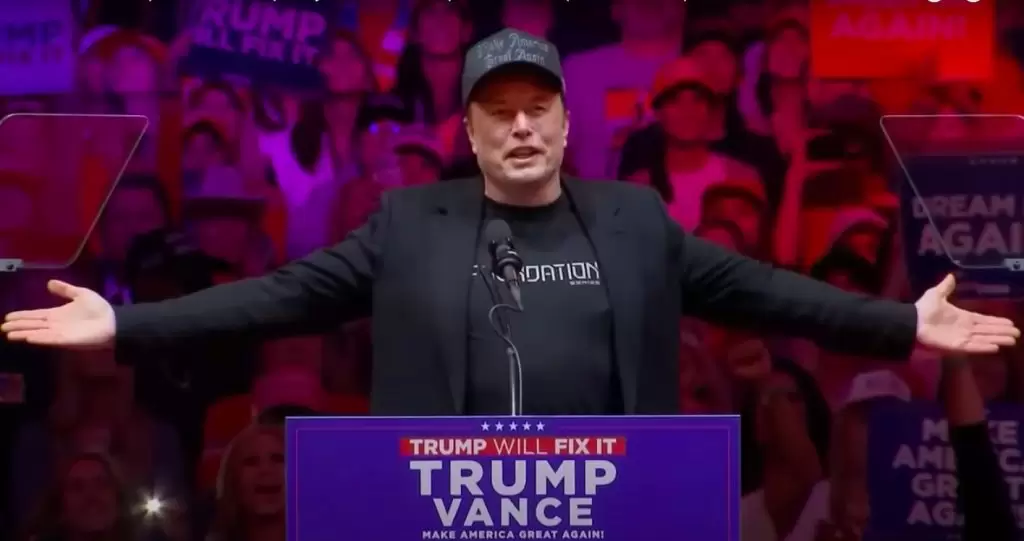
Elon Musk, a prominent tech billionaire and vocal supporter of Donald Trump, recently voiced his full support for the President-elect’s plan to end social media censorship, a growing issue that has impacted millions of Americans, including Trump himself.
Musk shared a 2022 video in which Trump outlined his Free Speech Policy Initiative, adding an emphatic “YES!” in support of the proposal. In the video, Trump emphasized that without free speech, America risks losing its very identity as a free country. “If we don’t have FREE SPEECH, then we just don’t have a FREE COUNTRY. It’s as simple as that,” Trump stated. “If this most fundamental right is allowed to perish, then the rest of our rights and liberties will topple just like dominos.”
Trump’s plan, which he pledged to implement upon his inauguration, calls for aggressive action against a left-wing censorship regime. This initiative, he argues, involves a vast conspiracy among Silicon Valley, government bureaucrats, and mainstream media to suppress vital information on crucial matters, such as elections and public health.
The plan includes several key actions aimed at dismantling censorship and restoring free speech in the U.S. The first step, according to Trump, would be an executive order banning any federal department or agency from collaborating with private organizations to censor lawful speech. Trump also pledged to cut federal funding for any efforts aimed at labeling speech as “misinformation” or “disinformation.”
“Within hours of my inauguration, I will sign an executive order banning any federal department or agency from colluding with any organization, business, or person to censor lawful speech,” Trump explained in the video. This would be followed by a directive to investigate and prosecute any parties involved in the growing censorship system, including violations of civil rights, election laws, and anti-trust laws.
Trump’s second major move would be a revision to Section 230 of the Communications Decency Act. The revised law would require large online platforms to meet higher standards of neutrality, transparency, fairness, and non-discrimination to qualify for immunity under Section 230. This would limit the platforms’ ability to restrict lawful speech, while still allowing them to take down unlawful content such as child exploitation or terrorism-related material.
In addition to these measures, Trump has called for the dismantling of the entire censorship apparatus that has been built in the name of combating “misinformation.” His plan includes an immediate halt to federal funding for non-profits and academic programs that support censorship, and he has proposed significant penalties for universities found guilty of censorship practices, including the loss of federal research dollars.
Trump proposes a mandatory cooling-off period of seven years before former intelligence officials (FBI, CIA, etc.) can work for tech companies that hold vast amounts of user data. This is to prevent conflicts of interest and undue influence over platforms.
Finally, Trump calls for a digital Bill of Rights that would give citizens the right to due process if their online content is censored. Users would have the right to know why their content was removed, to appeal decisions, and to opt out of content moderation altogether.
Musk’s endorsement of Trump’s plan comes at a time when concerns about online censorship and freedom of speech are growing. Many believe that the censorship regime has disproportionately affected conservative voices and other dissenting opinions, particularly during key political events such as elections. By advocating for these changes, Trump aims to give Americans the right to free speech without interference from powerful tech companies or government entities.
“Once you lose your borders, once you lose your elections, you no longer have a country,” Trump added. He stressed that the fight for free speech is critical not only for the survival of America but also for Western civilization itself. “By restoring free speech, we will begin to reclaim our democracy, and save our nation,” he concluded.